
Amazon FBA Fees Are Rising Again And Sellers Are the Ones Paying the Price

If it feels like Amazon FBA Fees never stop going up… you’re not imagining it.
In yet another update that’s likely to frustrate sellers across the board, Amazon has announced a 3.5% fuel and logistics surcharge on fulfillment fees starting April 17, 2026. While the company positions this as a necessary response to rising operational costs, many sellers are asking the same question:
How much more are we expected to absorb?
Let’s break down what this means—and why this latest increase in Amazon FBA Fees is hitting a nerve.
What’s Changing (and When)
Amazon’s new surcharge will impact multiple programs:
- April 17, 2026
Applies to:- Fulfillment by Amazon (FBA) in the US and Canada
- Remote Fulfillment (US to Canada, Mexico, Brazil)
- May 2, 2026
Expands to:- Buy with Prime (US)
- Multi-Channel Fulfillment (MCF) in the US and Canada
The surcharge is calculated on fulfillment fees—not product price, averaging around $0.17 per unit in the US.
On paper, that might not sound dramatic. But for high-volume sellers or low-margin products, even small increases in Amazon FBA Fees can quietly erode profitability.
“We Absorbed Costs”… Until Now

Amazon states that it has been absorbing rising fuel and logistics costs “so far,” and that this surcharge is relatively low compared to other carriers.
That may be true.
But from a seller’s perspective, the reality looks different:
- Fees have steadily increased year after year
- New surcharges are becoming more frequent
- Margins are getting tighter with every update to Amazon FBA Fees
At some point, “temporary” adjustments start to feel permanent.
Why Sellers Are Frustrated
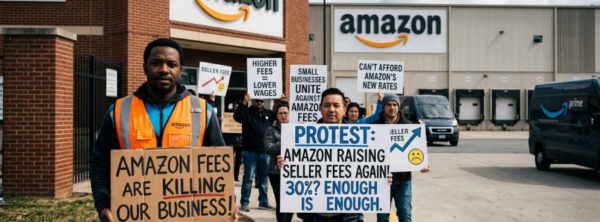
This isn’t just about a 3.5% increase. It’s about the pattern.
Sellers have already navigated:
- Storage fee hikes
- Placement fees
- Returns processing costs
- Inventory restrictions
Now, another layer is added to Amazon FBA Fees—one that’s tied to unpredictable external factors like fuel prices.
And that’s where the frustration really kicks in:
👉 Sellers have zero control over these costs
👉 Yet they’re expected to continuously adapt pricing and operations
For many, it feels like running a business where the rules—and the costs—keep changing.
The Real Impact: Death by a Thousand Cuts
Let’s be honest: $0.17 per unit isn’t what breaks a business.
But stack that on top of everything else, and suddenly:
- Margins shrink
- Ad spend becomes harder to justify
- Price increases risk killing conversion rates
This is the compounding effect of rising Amazon FBA Fees.
And for sellers operating on thin margins (which is… most sellers), these incremental changes add up fast.
Amazon’s Tools: Helpful, But Not a Solution
Amazon points sellers toward tools like:
- Revenue Calculator
- Profit Analytics
- Fee Preview Reports
These can absolutely help you understand the impact of Amazon FBA Fees.
But let’s be clear:
- These tools don’t reduce costs
- They just help you measure them
Knowing you’re losing margin doesn’t fix the problem—it just confirms it.
What Sellers Should Be Doing Right Now

With yet another increase in Amazon FBA Fees, being reactive isn’t enough. You need to stay ahead.
Here’s where to focus:
1. Re-evaluate Your Margins
Run updated calculations with the surcharge included. Some products may no longer be viable.
2. Optimize Packaging
Since fees are tied to size and weight, even small adjustments can offset rising Amazon FBA Fees.
3. Audit Your Account
This is where many sellers are leaving money on the table. Lost, damaged, or incorrectly charged inventory can quietly drain profits.
4. Revisit Pricing Strategy
Not every increase can be absorbed. Strategic price adjustments may be necessary—but need to be done carefully.
The Bigger Picture
Amazon isn’t alone in facing higher logistics costs. The entire industry is feeling it.
But here’s the difference:
Most sellers don’t have the ability to pass costs down as easily as Amazon does.
So while Amazon frames this as a modest, necessary adjustment, for sellers it’s another reminder of how dependent their business is on a platform they don’t control.
And every increase in Amazon FBA Fees reinforces that reality.
Final Thoughts
This latest surcharge might be labeled “temporary,” but if history tells us anything, it’s that fees tend to move in one direction: up.
For sellers, the takeaway isn’t just about this specific change—it’s about staying proactive in an environment where Amazon FBA Fees are constantly evolving.
Because if you’re not actively protecting your margins…
No one else will.