Amazon Reimbursement Value in 2026: The Reason You’re Still Leaving Money on the Table
Amazon already changed how reimbursements work—and many sellers still haven’t caught up.
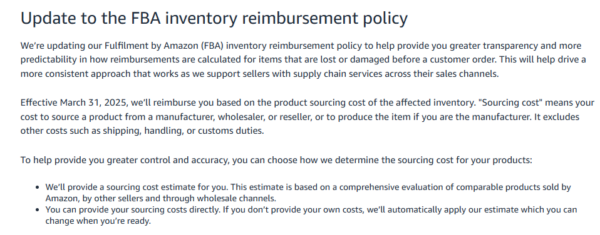
As of March 31, 2025, Amazon shifted away from estimated selling prices and now calculates reimbursements based primarily on sourcing cost (COGS). This change directly impacts how much you recover from lost or damaged inventory.
Despite Amazon communicating this update—and service providers reinforcing it—there’s still a major gap in execution.
Many sellers have not updated their sourcing costs.
Which means Amazon is still estimating them.
And those estimates often result in a lower Amazon reimbursement value than what sellers are actually entitled to.
What Changed and Why It Matters
Before March 2025, reimbursements were often based on estimated selling price or a calculated market value.
Now, Amazon relies on:
- Your submitted sourcing costs
- Verified cost data
- Supporting documentation
If your data is accurate and up to date, reimbursements reflect your real costs.
If not, Amazon assigns a value for you—and that’s where discrepancies begin.
Why Your Amazon Reimbursement Value May Be Lower Than Expected
Many sellers assume that if they’re receiving reimbursements, everything is working correctly.
But that’s not necessarily true.
If your sourcing costs are:
- Missing
- Outdated
- Incomplete
Then Amazon is calculating reimbursements using internal estimates.
These estimates are typically based on:
- Category averages
- Comparable ASINs
- Historical pricing trends
And while that might sound reasonable, it often leads to a lower payout than your actual cost—reducing your overall Amazon reimbursement value.
The Hidden Risk of Letting Amazon Estimate Your Costs
Amazon’s goal is consistency—not maximizing your reimbursements.
So if your business has:
- Higher-quality sourcing
- Increased supplier costs
- Bundled or customized products
Amazon’s estimated cost may not reflect that.
Example
- Amazon estimated cost: $10
- Your real landed cost: $15
That’s a $5 difference per unit.
Now multiply that across:
- Lost inventory
- Damaged units
- Fulfillment center errors
This gap can significantly reduce your total recovery over time.
The Overlooked Tool That Controls Your Reimbursements
Amazon provides a tool specifically designed to manage this: the Manage Sourcing Cost portal.
Inside this portal, you can:
- Review the cost Amazon has assigned to your SKUs
- Identify discrepancies
- Submit updated sourcing costs
But here’s what we consistently see:
Many sellers have never reviewed this section—or haven’t updated it since the policy change.
That means their reimbursements are still based on outdated or estimated data.
How to Increase Your Amazon Reimbursement Value Using COGS

If you want to maximize what you recover, this is one of the most important actions you can take.
Step 1: Review Your Current Cost Data
Go into the Manage Sourcing Cost portal and analyze what Amazon currently has on file.
Focus on:
- High-volume SKUs
- High-cost items
- Products with frequent reimbursement activity
Step 2: Identify Where Value Is Being Lost
Compare Amazon’s estimated cost with your actual landed cost.
Look for:
- Underestimated products
- Missing cost data
- Outdated sourcing costs
Every mismatch represents lost revenue.
Step 3: Submit Accurate Sourcing Costs
If you find discrepancies, submit updated cost data through the portal.
Keep in mind:
- Accuracy is critical
- Consistency across SKUs matters
- Not all updates are automatically approved
Step 4: Support Your Data with Documentation
Amazon may request proof before accepting updated costs.
Be prepared to provide:
- Supplier invoices
- Proof of payment
- Manufacturing documentation
Without proper documentation, updates may be rejected—even if your costs are correct.
Why This Matters More Than Ever
Amazon has become stricter across the board.
We’re seeing:
- Tighter validation processes
- Increased automation
- More structured reimbursement policies
This means:
- Claims are harder to win
- Errors are harder to dispute
- Accuracy matters more than ever
As a result, your Amazon reimbursement value is no longer just about finding reimbursements—it’s about ensuring they’re calculated correctly from the start.
The Real Cost of Ignoring This

Let’s be clear: this isn’t a small optimization.
If reimbursements are underestimated by even a few dollars per unit, it adds up quickly.
Across dozens—or hundreds—of claims, this can mean:
- Thousands in lost reimbursements
- Reduced profitability
- Missed recovery opportunities
And the worst part?
Most sellers don’t even realize it’s happening.
Why Most Sellers Haven’t Fixed This Yet
Even though the policy changed in 2025, many sellers still haven’t updated their sourcing costs.
Why?
- Lack of awareness
- Confusion about documentation requirements
- Assumption that estimates are “close enough”
But “close enough” is exactly what reduces your Amazon reimbursement value over time.
Final Takeaway
Amazon already made the shift.
Now it’s up to sellers to respond.
If you haven’t reviewed your sourcing costs, there’s a high probability that:
- Amazon is estimating your costs
- Your reimbursements are lower than they should be
- You’re leaving money on the table
Updating your COGS is one of the most effective ways to improve accuracy, increase recovery amounts, and ensure you’re getting what you’re actually owed.

FAQ
What is Amazon reimbursement value?
It’s the amount Amazon pays sellers for lost, damaged, or mishandled inventory, typically based on sourcing cost or estimated values.
How can I increase my Amazon reimbursement value?
By updating sourcing costs, providing accurate documentation, and regularly auditing your account.
Does Amazon still estimate reimbursement amounts?
Yes—if sourcing costs aren’t provided, Amazon will estimate them, which can result in lower payouts.
How RefundPros Helps
At RefundPros, we go beyond identifying missed reimbursements.
We help sellers:
- Identify gaps in their recovery amounts
- Flag underestimated claims
- Improve cost accuracy to maximize payouts
Because today, it’s not just about recovering money, it’s about making sure your reimbursements reflect what you’re actually owed.